

Connecticut has always punched above its weight economically. With a GDP per capita ranking consistently among the highest in the nation, the state is home to a dense network of small businesses that form the backbone of communities from Mystic to Torrington. But a persistent gap remains: too many of those businesses are operating without a credible online presence, and it is costing them.
The State of Small Business in Connecticut
There are roughly 350,000 small businesses in Connecticut, accounting for nearly 99% of all businesses in the state and employing close to half of the private-sector workforce. These are the contractors in Tolland County, the family restaurants in Middlesex County, the boutique retailers in Hartford that have been operating out of the same storefront for decades.
The conditions are not easy. Connecticut consistently ranks among the more expensive states to operate a business in, with high commercial real estate costs, energy costs above the national average, and a tax structure that requires careful navigation. The post-pandemic recovery has been uneven. Some sectors, particularly trades, home services, and healthcare-adjacent businesses, have seen sustained demand. Others in hospitality and retail have had to restructure significantly.
Against that backdrop, every competitive advantage matters. And one of the most accessible advantages available, a functional, professional website, remains underutilized.
The Numbers Tell a Clear Story
Consider the consumer behavior that now surrounds every purchasing decision. According to data from BrightLocal and similar research firms, over 90% of consumers use the internet to find local businesses. Of those, a substantial majority form an opinion about a business based on its website within seconds of landing on it.
A bad website, or no website at all, does not register as neutral. It registers as a red flag.
Google’s local search algorithm factors in a business’s online presence when determining which results to surface for searches like “electrician near Hartford” or “tax prep Middletown CT.” A business without a website is operating at a structural disadvantage in those results, regardless of how good the work actually is.
The average consumer under 50 now assumes that a business without a website either does not exist or is not serious. That assumption is unfair to the thousands of legitimate Connecticut small businesses that have been operating on referrals and word of mouth for years. But the assumption is real, and it has measurable consequences.
What a Small Business Website Actually Does
The framing of “a website” often leads business owners to think in terms of a brochure: static, informational, something to check off a list. That framing undersells what a well-built site actually accomplishes.
A website is a 24-hour sales and credibility asset. It answers the questions a potential customer would ask before picking up the phone. It displays past work, certifications, service areas, and pricing context. It captures leads at 11pm on a Sunday when no one is in the office. For service-area businesses in Connecticut, where the difference between Hartford, the Farmington Valley, and the shoreline can mean entirely different customer bases, a well-structured site with geographic targeting can separate a business from competitors who have not done that work.
For businesses in trades and professional services, a website also supports the referral process. When a satisfied customer recommends a contractor to a neighbor, the first thing that neighbor does is search for the business online. If nothing comes up, or what comes up looks outdated and neglected, the conversion from referral to booked job is at risk.
The Local SEO Opportunity in Connecticut Is Real
In major metros, ranking well in local search is highly competitive. Connecticut is different. In most counties and smaller cities across the state, the bar for appearing prominently in local search results is lower than most business owners assume. A properly structured website with relevant geographic keywords, a verified Google Business Profile, and consistent NAP (name, address, phone) data across directories can move a business from invisible to page one for its core service terms in a matter of months.
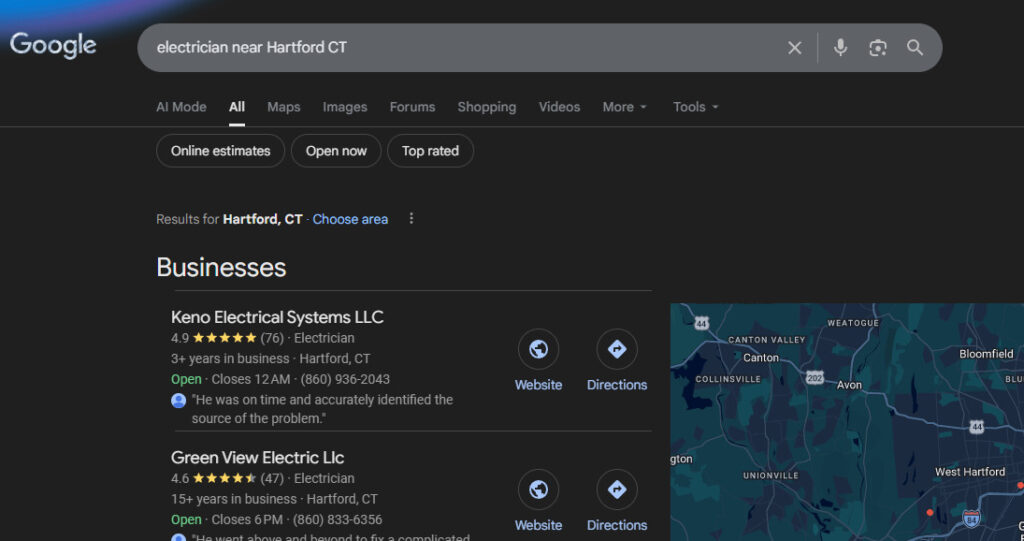
This is not a guarantee. It requires ongoing attention and occasional updates. But the competitive environment in a market like Tolland County or Middlesex County is categorically different from trying to rank in Boston or New York. The opportunity cost of not doing it is high.
The Bottom Line
Connecticut small businesses are operating in a challenging environment. Margins are tight, labor is competitive, and customers have options. A professional website does not solve all of those problems, but it addresses one of the most preventable ones: being invisible or unconvincing to someone who is actively looking for what you offer.
The investment is modest relative to the exposure it creates. The barrier to entry has never been lower. The businesses that are building and maintaining their online presence now are capturing customers that their competitors are not even aware they are losing.
That is a correctable problem. The first step is recognizing that a website is not a luxury or a marketing add-on. It is infrastructure.
Ready to Fix That?
At Arcane Tech Solutions, we build websites for small businesses in Hartford, Tolland, and Middlesex Counties. No templates handed off without context, no bloated agency overhead. Just clean, functional sites built to rank locally and convert the traffic they earn.
If your business does not have a website, or has one that is no longer working for you, let’s talk about what it would take to change that.